--SACHET NAIK
II YEAR, MBA ++
Indian Cricketers are an institution in themselves. With a billion plus fan following, advertisers
continuously turn to them, resulting in each cricketer earning more than what many of the small and
medium Enterprises do. So let’s see what management lessons we can learn from them.
Rahul Dravid gives us an example as to how patience, perseverance and readiness to adapt can

He
seemed perfect for test cricket but his critics deemed him unsuitable for one day format. He was
criticised over and over again for his defensive play, rendering him in and out of India’s one day team.
But he persisted in capitalizing on whatever opportunities he got. Serving in all fielding positions from silly point up to the slips, he did not back out even when he was asked to dawn the keeper’s gloves and
take position behind the wickets. Dravid superbly adapted his game and patiently developed it.
Whenever the team needed him, he was there. He stood like a wall guarding one end giving batsman at
the other end freedom and confidence to play their shots. By his sheer persistence and commitment
towards the game, he went on to play numerous match winning innings for India in both forms of the
game.
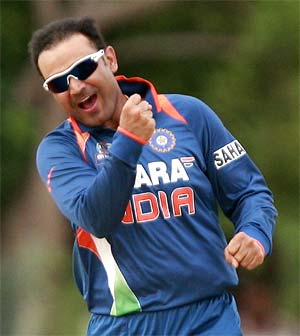
Unlike Dravid, Virender Sehwag is a cricketer with an unorthodox technique which cricketing
gurus won’t necessarily advocate to youngsters. Cricket of the earlier times had seen many such players
such as Sir Vivian Richards, who played with an unorthodox style characterized by spontaneity and
flamboyance that emerged and declined in a hurry. Virtue of these players with such a natural talent has
been their inconsistency. Be it Shahid Afridi, Yousuf Pathan etc... such players fight to prove their talent
to themselves as well as the world. Virender Sehwag has managed to kill the devils that clutter his mind.
He has been able to understand his strengths and play to them. He keeps things simple when he says,
“See the ball, and hit the ball.” This shows an uncluttered mind which gives him an ability to perform
against all odds. Although lacking in consistency of a Dravid, he has the sheer flamboyance and
aggression that makes many competent bowlers weak in the knees.
Sachin Tendulkar entered international cricket in an era when cricket was seeing tremendous,
fast paced changes. After 1991 privatisation, cable TV started increasingly penetrating Indian
households. With this new found audience came increased fame and newer opportunities for cricketers.
The torch bearer of this growth of Indian cricket was Sachin Tendulkar. Here was an immense talent,  blessed in all departments of the game be it batting, bowling or fielding. And he displayed his talents
 with critical performances against a variety of oppositions, which now are a part of cricket’s legacy.
Today he continues to go from strength to strength, still serving as a pillar of the Indian team in both
forms of the game.
Leadership lessons can best be learnt from Mahendra Singh Dhoni, Captain of the Indian team. Coming from a small town with a humble background to reaching the topmost position in Indian cricket,
Dhoni has caught the imagination of the whole world. He has given hope to many youngsters that, ‘THEY
TOO CAN DO IT’. He may not have been the best of batsmen or wicketkeepers that have made the team
 but, by believing in himself and adjusting according to the demands of the situation, he has achieved
 achieve their true potential. He is known best for keeping things simple and maintaining his composure
in the most nerve wrecking situations. Dhoni has brought a new attitude in the team. Due to him the
team is now more assertive rather than attacking.
Companies operating in a growth economy wherein they have a variety of opportunities face
the dilemma: What to do? How to grow? Sportspersons like Sachin or Dhoni give the answer by way of
their performance, reminding such companies about the need to concentrate on doing what they do
best and then slowly developing expertise in diverse fields. By doing so, companies not only become
leaders in their core field, but also harness the core competence developed in core field to reap
opportunities offered in diverse fields. Following such a strategy smoothens the organization’s learning
curve, allowing it to easily transit into diverse fields.
As a management student set to enter the battlegrounds of business, I see many parallels here.
Ultimately, for any player/individual, the biggest task he/she faces is managing himself/herself. How
he/she deals with failure [& more importantly success] determines how far he/she goes. We have
witnessed many examples of what easily acquired fame/glamour and money does to people. The player
needs to choose between what he wants to do and what he is expected to do. He needs to recognize
and implement the fact that his responsibilities towards the team come before everything else. He has
to choose between his needs for enjoyment, be it in the glamour of parties, events and advertisement,
his own need for records, expectations of fans - to entertain by hitting big shots on each occasion, and
expectation of his own team to deliver winning performances. So there are number of choices available,
but players like Dravid and Sachin choose to do what has to be done in the best interests of the team. If
the team wins, everything else falls in place. To do this requires great strength of character and immense selfcontrol.
the team wins, everything else falls in place. To do this requires great strength of character and immense selfcontrol.